Showing posts with label Pork. Show all posts

Saturday, February 25, 2012

Rosemary Red Wine Pulled Pork w/ Armagnac Prunes

This giant pot of awesome came about because I was having some friends over for a dinner party & the main course request was for pork. I have made something very similar with lamb before, so I decided to give it a whirl with pork instead. Also, the fact that pork shoulder costs quite a lot less than a similar cut of beef or lamb makes it a good choice for feeding a crowd on a budget. And right now I don't know anyone who isn't on a budget.

As with all slow-cooked foods, this tasted even better on Day 2, so consider making this in advance if you choose to entertain with it.

Start by breaking down a 6lb pork shoulder (or "butt") into fairly equal size cubes, roughly 2 inches square each. You can skip this step and just get pork stew meat from your butcher, but I dislike buying the random cubes. 
However if you are less than secure in your knife skills, or squeamish about having to skin and cube the shoulder yourself, by all means get the butcher to do it for you.
I would recommend buying some loose pork bones from your butcher tho (about 2 lbs). The recipe does not call for them, but they will add a bit of richness to your final product, not to mention you might get lucky and find a little marrow to snack on at the end of the cooking process.

In a small bowl to the side, have about 20-30 prunes, roughly chopped, soak in about 1 cup of Armagnac (or brandy) for 1 hour. Stir occasionally to make sure they all have time to pick up some flavor.

In your heavy-bottomed pot, heat a little olive oil and brown your (seasoned) pork cubes in batches. Try not to rush this step as it adds a nice level of flavor to the finished product. Set aside the browned pieces in a bowl, making sure not to lose any juices that accumulate.

Next: Bacon.
I add about 4-5 slices to the bottom of the pan (heat reduced to medium-low) and render until crispy.
Remove cooked bacon.
Feel free to snack on this, or save to add back into the pot at the end as you prefer.

Into the rendered bacon fat over medium heat goes 1 large diced onion and 4-6 large peeled & chopped carrots. When the onions start to become translucent I add in 4 minced cloves of garlic and allow them to become fragrant for another minute or so.
Then add in the prunes with their Armagnac and stir to get any remaining brown bits (fond) off the bottom of the pot.

Return the browned pork to the pot along with any juices in the bowl. Add in the pork bones if you have them, your bouquet garni, and 1 bottle of red wine.
As always, the rule with the wine is to only use something you would actually drink.
I also add in about 3/4 cup of ruby port, as I like the richness it adds to the finished dish.
Resist the urge to add stock to this mixture, even if you are afraid the liquids do not come up high enough in your pot. Adding stock will vastly change the finished product, leaving you with something quite loose and lacking the rich flavor. 
The finished product should be dense and almost sticky.

For the bouquet garni: 3 rosemary stems, 3 fresh thyme stems, 2 bay leaves
I put all of this in a loose tea bag or cheese cloth tied with twine, along with about 8 black peppercorns I crush under the flat of my knife.

Bring the whole mixture to a simmer on your stovetop and then transfer to a 320º oven for 3 hours, lid on, stirring once or twice along the way.

                 
The result should be dense, slightly sweet, and nicely caramelized with very little liquid left at all in the pot.

Remove the bouquet garni & bay leaves, and I find the easiest way to break everything down is with a potato masher. Gently crush the cubes of meat until you have a gently shredded/pulled consistency.

I chose to serve this over polenta, but it would also go very well over either quinoa or couscous. If serving this over polenta, keep it simple. Do not add a ton or milk or cheese to the bubbling mixture. Just water or stock, salt, and maybe a little butter at the end.

As I said, this followed the rule of tasting better on Day 2, so if you have the time try to make it a day in advance. Especially as breaking down the shoulder and browning all the meat takes quite a bit of time, so you might even want to do that the day before if you don't have time to do it all in one day.
Either way, this dish was a BIG hit with my friends, and it easily fed 6 hungry people with leftovers.
Try it out before the cold weather passes.


Sunday, October 16, 2011

Kale & Leek Leftover Soup

The more I cook, the more I am into making leftovers into soup.
I didn't have the soffritto trifecta of celery, carrot & onion on hand with which to start this soup, but it still turned out nicely.


This time I had half a roast pork tenderloin leftover as the hubs was 3,000 miles away with his family, and I had already made 2 meals out of the first half.
So, soup it is!

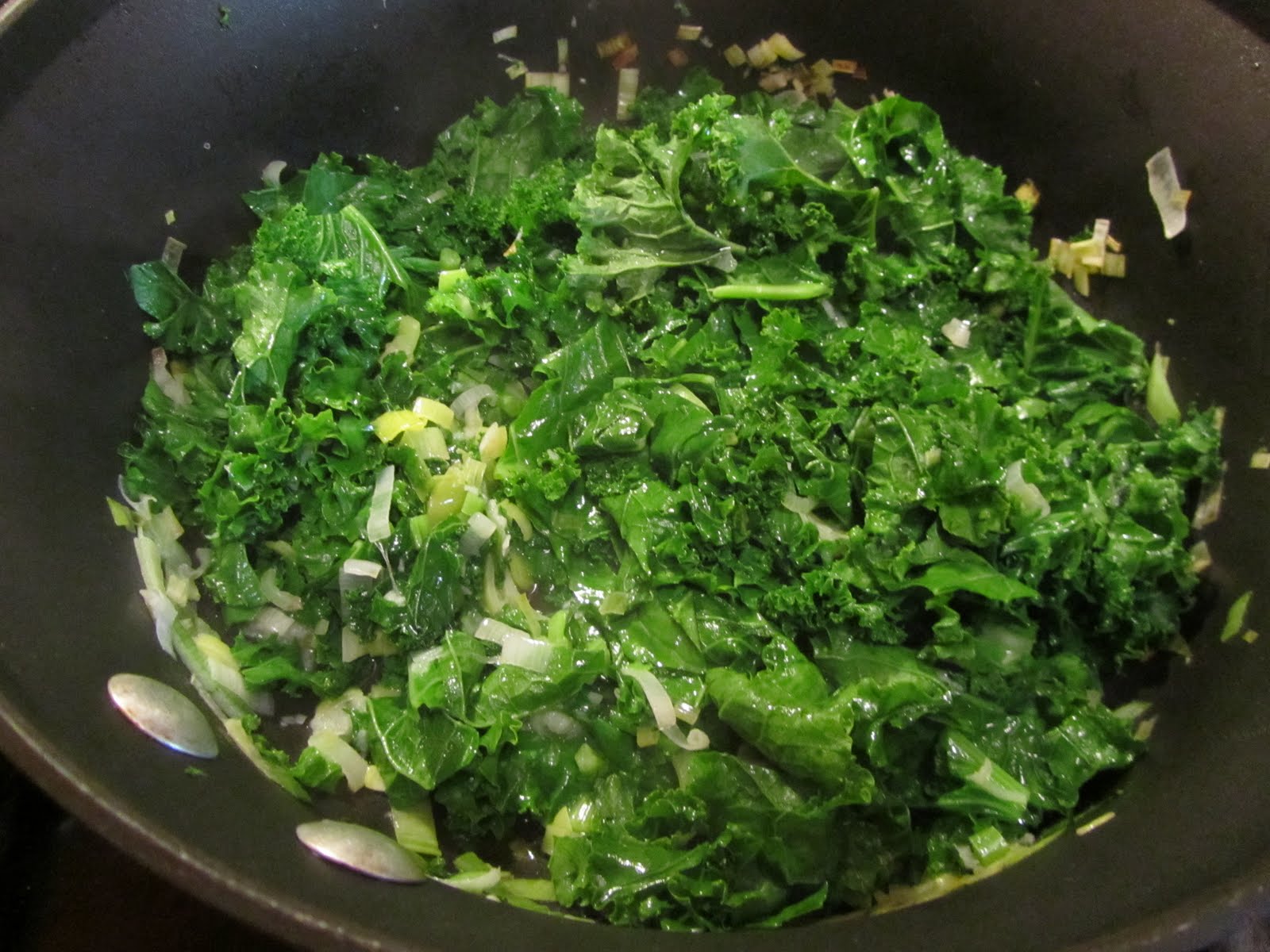
I started by sautéing half a leftover leek in some bacon fat and olive oil (also leftovers from making the Linguine w/ Clams, Leeks & Bacon) with the stems of the kale with a pinch of salt.
Halfway thru the wilting process I added 2 cloves of garlic, minced.

Chop the kale leaves into manageable pieces and add to the pan with a splash of white wine.
Add the lid to wilt.

While the kale is wilting I purée one can of white beans with some chicken stock. If you prefer, keep your beans whole. I like how puréeing them thickens the whole soup.

Add the beans and season with salt and an optional tsp of ground rosemary.
(My pork tenderloin had been cooked with rosemary and sage, so I did not add extra to the soup, fearing it would overwhelm the final product.)

Cover everything with chicken stock, add a hearty handful of grated parmigiano reggiano, and bring to a simmer.

I dice up the leftover pork (note it is nice and pink in the middle) and keep it wrapped in the fridge to add a little bit per portion once the soup has already been reheated. That way the pork does not get overcooked or tough. Instead the heat from the soup warms each bite thru while maintaining its tender texture.

The bacon from the beginning adds a background of smokiness, the leeks add sweetness, the beans protein and body, the kale is a superfood, and the tender bites of pork are always a treat.
I love making Leftover Soup!

Monday, July 11, 2011

Pork Milanese

Anything "Milanese" really just means breaded, and possibly pounded out flat.
So this time it's pork loin chops, not pounded out, because I prefer there to be more meat than breading in each bite.
But to each their own.

Standard lineup of flour, beaten egg, and then a combination of panko bread crumbs with a bit of grated parmigiano reggiano mixed in.

Room temperature one inch thick pork loin chops, which I season with salt and a bit of dried ground sage before going through the breading process.

In a skillet on medium high with a tablespoon or two of olive oil in it, cook in batches, making sure not to crowd the pan so the chops get crispy rather than steamed, about 3-4 minutes per side.
You may have to add more oil to the pan when you flip, as the breadcrumbs will absorb some of it as they cook.

Hideous photo, but tasty food.
Finish with a spritz of lemon juice and a side of vegetables, and dinner is done.
Stay tuned for my clever use of the leftover breading assembly line!

Thursday, April 21, 2011

Tangy Asian Tenderloin

So remember when I wrote about the Tangy Asian Chicken Thighs that I just could not stop eating? No? Ok well look back here.

I knew when I created the marinade that it would be brilliant on pork as well, and last night I tested my theory. And I was right. SO good.
And the same proportions used on 6 chicken thighs worked on one 1.25 pound tenderloin.
3 TBSP honey
2 1/2 TBSP soy sauce
3 cloves of garlic, grated
2 inches of fresh ginger, grated

For my basic How To on cooking a pork tenderloin, see here.

Step one: marinate a few hrs in the fridge. 
Looks kinda gross, I know, but it will be so tasty in the end.

Take the meat out of the fridge and LET IT COME TO ROOM TEMPERATURE
Preheat your oven to 400º and set your pan to medium heat w/ just enough olive oil that your meat won't stick. I was using a non-stick pan, so I only used a small drizzle.

Slapdash photo, I know.
Cook on the first side seven minutes.
Then flip and place pan in the oven for another seven minutes.
Remove from pan and let rest, and place the leftover marinade in the hot pan to reduce to a delicious sauce. Remember to cover the pot handle with something, as that sucker has been in a 400º oven.

Super crap photo. Apologies.
Just like last time I served this with some seasoned quinoa, and roasted a mix of broccoli and cauliflower, because that's what I had goin' on in my fridge.

For the quinoa (keen-wah): follow package instructions, and when it is done but still in the hot pan, I sprinkle in some kosher salt and good olive oil. For this meal, I also mixed about a tablespoon of honey with a tablespoon of soy sauce, and poured that mixture over the hot quinoa and stirred well to combine. That made it so the quinoa also had a sweet and tangy flavor that tied it into the meal, but not the ginger/garlic bite that the pork had.

For the mixed veg: cut up your stalks into medium sized florets, drizzle with olive oil and salt, and roast in a 400-425º oven for 20 minutes. Done.

I don't know if this is like the time I was ordering spring rolls from the local Thai place 2-3 times a week for a solid month before OD-ing on them, but I cannot get enough of this marinade at the moment.
And the leftover pork would make a killer sandwich... maybe a panini on ciabatta with some extra sauce and some grilled eggplant. Hmmm... will have to look into that in the future ;)


Friday, February 25, 2011

Sherry Baby

This is only subtly different from the sauce that I like to make with a seared duck breast, but it was just as addictive and really made what could be a bland pork dinner pop.


Note: I would suggest using this sauce over pork chops, rather than a pork tenderloin. It's just that I tend to buy tenderloins because I prefer the texture.

Start by seasoning your pork with salt and a little chopped fresh thyme.
Sear it in a pan with a touch of olive oil, and finish it in a 425º oven* until just pink in the middle, 7-12 minutes, depending on size.
Set aside to rest.

*If doing pork chops, the pan alone should suffice.
Arty Shallots
 Add a bit more olive oil to the pan and start to cook 1 small shallot, medium slice, on medium heat.

Once the shallot has started to soften and almost color, add one clove of garlic, minced, and give that another minute to cook and become aromatic.
Next add 1 tsp of dried thyme (or rosemary if you prefer), 1/2 cup chicken stock, and 1/3 cup dry sherry to the pan.
Stir to pick up any brown bits from the pork and season with a pinch of salt.

Crank the heat to medium high and add 1 1/2 TBSP of cherry preserves.
(You can see the whole chunks of cherry in my pan.)
Stir regularly as the sauce reduces.

Getting there, but not quite ready...

NOW the sauce is ready!
Check one last time for seasoning (it should be sweet from the cherries and a bit aromatic from the sherry) and spoon over your pork.

I served the pork with prosciutto peas for a delicate sweet-yet-saltiness, and a dollop of cauliflower mash to cut the richness.
Enjoy.


Friday, February 4, 2011

Kitchen Sink Chili Soup


My friend was trying to help me come up with a name for this soup, and as she thought it had some good Italian leanings we were trying to look up how to say "kitchen sink" in Italian.
We failed.
That, or "Acquiao Chili Soup" sounded even more unclear to us.

The "kitchen sink" aspect of this soup comes from the fact that when I first made it, I was simply using up items in my fridge, which often leads to tasty cooking discoveries. This time I had some almost-wilting kale, the usual celery and carrots, and some leftover rosemary pork tenderloin from dinner that wasn't enough for a meal by itself. So, I diced it up and put it in the bottom of my bowl when I ladled the soup on top... and it was DELICIOUS!

Other guests to this party (read: soup) include shallot, garlic, chicken stock, white wine, white beans (always in the pantry for adding body, protein, and fiber), cumin, oregano, & chili powder.

You may recognize the seasonings from my favorite Chicken & White Bean Chili. Well, that's why this soup was named Kitchen Sink Chili Soup. Also, if you have swiss chard or some other hearty winter green, by all means use that. I just buy (and thereby cook with) kale the most because it is so heavily packed with vitamins and other good things, and it really does stand up to sitting in a pot full of hot soup, unlike spinach and arugula.
(Wusses...)

Step one: soffritto. Dice 1 medium shallot, 2 medium carrots, and one long stick of celery and sauté in olive oil on medium heat until tender with a pinch of salt.

More fun with macro
I separate the stems of the kale and dice them to a similar size as the soffritto and throw them in the pot to soften at the same time.

While these four ingredients are softening, chop up the greens of the kale and set aside. Take 2-3 cloves of garlic and finely chop them as well, and measure out 1 tsp of cumin, 3/4 tsp oregano, and 3/4 tsp of chili powder.
When the veggies have softened (less than 10 minutes if you've done a fine dice) add the garlic and spices and allow them to cook out another minute.

Note: It is possible at the end that you might want to add a bit more seasoning. I find that the beans can absorb a lot of salt and other seasonings, and sometimes I need to adjust before serving.

See that? That's how much white wine I used.
Less than or up to 1/4 cup. Just enough for a little background depth of flavor, and something for the garlic to simmer in for another minute or two.

Next add your chopped kale leaves and about a cup of chicken stock.
Stir, add the lid, and allow the kale to wilt down a bit.
While that's happening...

Notice how the circumference of the can is slightly wider than the circumference of my immersion blender? I love this trick.
I remove the white beans from the can and rinse them in cool water in a mesh strainer. Then I put half the beans back in and add just enough chicken broth to cover them, and then I use the immersion blender inside the can to purée the beans. Two rounds of that and a little extra stock to rinse out the can and I have saved myself a lot of cleanup.
You, however, do not need to purée your beans in your soup.
I'm just weird about white beans and like them to be invisible.

Add your beans to the pot and fill with however much stock makes you happy for your soup. If I'm in the mood for broth-y soup I probably use around 3 cups. If I want it thicker, less than 3 cups, OR I add another half can of puréed white beans to the mix.
Salt your soup again, as the beans will absorb.
Bring up to a simmer and check for any other seasoning adjustments.

Now comes the time for the leftover rosemary pork tenderloin. Dice it into bite-sized pieces and portion it out into the bottom of your serving bowls and ladle the hot soup on top.

I garnish with a little grated pecorino cheese and call it tasty.

Yes, this soup is still good without the leftover pork, but I HIGHLY recommend not skipping that step. It adds a wonderful depth of flavor. And do not throw it into the actual pot of soup, because then it will cook through all the way and lose all of that velvety tenderness that you got buy cooking it to a perfect light pink the night before. Just put a diced portion in the bottom of each bowl of soup and allow it to warm through that way, and they will be little gems of surprise deliciousness.
You won't regret it.
Unless you're kosher...

Friday, December 17, 2010

Express Porchetta

Craving porchetta but don't have a 4 lb. pork shoulder and 6 - 24 hrs to cook it?

I've got you covered.
You won't get the crispy skin cracklins, but at least you can hit all the flavor notes and quell your craving in about 30 minutes.
If you've got an hour, make this with a 2-3 lb. pork loin and you'll have enough to feed 4-6 people. But I'll write about that one another time.
This version is for a quick cooking 1lb pork tenderloin.


Sauté 1 small shallot (for a tenderloin) finely chopped, and 2-3 cloves of garlic, minced, in the fat of your choice. Olive oil will be the easiest, but if you have extra time, rendering a little pancetta fat will make your dish that much more delicious. (And keep that pancetta for the filling!)
Throw some chopped fresh rosemary (maybe 1 1/2 tsp) into the pan at the end to soften and become more fragrant, and let that cool.

Once more I butterflied the tenderloin and sprinkled 1 tsp ground sage, smoked salt (for more of that BBQ pit flavor, but regular kosher salt is important on the inside as well as the outside of the tenderloin, if you don't have smoked salt), a little black pepper, and only the lightest pinch of fennel pollen.
If you really like fennel, use more. We're fennel light-weights.
Top that with the cooled garlic/shallot/rosemary/pancetta mixture and tie shut.

Awaiting the sautéed goodness
Season the outside with salt and pepper, and sear in a touch of olive oil on medium high. Once fully browned, place in a preheated 425º oven until pink in the center, about 140º.

It's not cracklins, but it's crusty goodness.
Allow to rest about 10 minutes before slicing into it (but don't forget to remove the kitchen twine!)
While it rests, make some gravy.

Turn your pan drippings into the gravy of your choosing. Along with some chopped shallot and garlic, I used fresh sage and rosemary in mine, chicken stock, lemon, just a pinch of fennel pollen, and a pat of butter to finish it.

I served this up with carrots and a side of sautéed gnocchi instead of potatoes.

While it may not be a traditional proper porchetta, it should hit similar bells and whistles for you, and also be delicious in its own right.
And leftovers are fantastic on a crusty ciabatta for lunch!

Monday, November 15, 2010

Smoked Chipotle Pork

This meal came about for two reasons:
1 - The Spanican Chicken was über tasty, so the hubs requested more meals in that vein
2 - I bought some new smoked chipotle pepper flakes, and wanted to use them.

The marinade for this started out very much in the same vein:
1/2 tsp smoked Spanish paprika
1/4tsp chili powder
1/2 tsp cumin
1/4 tsp coriander
1/2 tsp dried oregano
1/2 tsp smoked chipotle pepper flakes
1/2 tsp salt
a pinch of cayenne (less than 1/8 tsp)
(above measurements are all approximations)
2-3 cloves of garlic, grated
1 1/2 TBSP olive oil

Stir all into a paste to combine and then rub into the tenderloin and refrigerate 3-4 hours.
When you're ready to cook and have let the tenderloin come to room temperature (20 minutes minimum) cook in a nonstick pan with only a splash of olive oil, about 6 minutes on the first side.
Then flip and place in a 425º oven for another 7 minutes or so, depending on the size of the tenderloin.

(.85lb-1lb tenderloins take roughly 7 minutes per side in my kitchen. 1.25lb - 1.75lb can take as much as 12 minutes per side. Read your package to determine the weight of your portion. These times are intended to leave you with a light pink center to the pork, but also, use common sense. If after 8 minutes your tenderloin is only opaque 1/4 of the way up, it needs more time before flipping.
For exact internal temperatures, refer to this post.) 

The char bits are flavor!
Remove the tenderloin to a separate plate and allow to rest 10 minutes before carving.

For the vegetable I made haricot vert, lightly sautéed with 1 very small clove of garlic, olive oil, salt,  and lemon juice. (Only about 1/4 of a lemon, or 1/2 tsp)
The brightness and crispness was a nice counter flavor to smokey tenderloin.

I rounded out the meal with a delicious side of leftover quinoa with chorizo, because what meal doesn't need more porky goodness?

If your family is craving something flavorful and smokey, this is your new go-to meal.